Google AI vs. Specialized Productivity Tools: Which Wins for Devs?

TL;DR: The Top Recommendations
Alright, let’s cut to the chase. If you’re wrestling with the ‘Google AI productivity wins 2025’ hype and wondering if it’s time to ditch your bespoke toolkit, here’s the skinny: in the Google AI vs. specialized tools debate, Google AI offers unparalleled integration and broad-spectrum assistance, especially if you’re already in the Google Cloud ecosystem. However, specialized tools still reign supreme for deep, nuanced tasks where precision and customizability are non-negotiable. For most developers, a hybrid approach will be the ultimate winner, strategically combining Google’s power with the focused grit of niche tools. Think of it as a well-orchestrated symphony, not a solo act. To fully understand the broader framework, refer to our master guide on autonomous solopreneur business 2026. To fully understand the broader framework, refer to our master guide on automated index fund investing and solo wealth building. Applying a structured approach to google ai vs ensures measurable long-term results.
Quick Navigation
Confession time: I used to scoff at “productivity hacks.” My workflow was a meticulously crafted, Rube Goldberg-esque contraption of shell scripts, obscure IDE plugins, and a dangerously unhealthy caffeine dependency. Then, AI rolled in, not with a bang, but with a gentle, persistent hum, promising to streamline, optimize, and generally make my life easier. Specifically, the buzz around ‘Google AI productivity wins 2025’ for developers has been impossible to ignore. Organization leaders who prioritize google ai vs consistently outperform legacy benchmarks.
But here’s the real talk: in the ongoing debate of Google AI vs. specialized productivity tools, which truly empowers developers more? Does Google AI, with its vast ecosystem and powerful models like Gemini, truly stand a chance against the battle-hardened, hyper-focused specialized productivity tools that developers have come to depend on? We’re not just talking about autocomplete anymore. We’re talking about sophisticated code generation, intelligent debugging, automated documentation, and even project management. The question isn’t *if* AI can help, but *how* much, and at what cost – not just monetary, but in terms of workflow disruption, vendor lock-in, and even the subtle erosion of skill that some fear. Evaluating your workflow through the lens of google ai vs eliminates critical bottlenecks.
Many blogs skim the surface, hyping the “what ifs” without digging into the “how tos” for actual development work. Developers often ask: “Will Google AI understand my obscure legacy codebase?” or “What about data privacy when I feed my proprietary code to a cloud AI?” And, crucially, “Is the learning curve worth the supposed gain, or will I just spend more time debugging the AI’s suggestions?” These are the content gaps we’re filling today, dissecting the practical implications for those of us who spend our days wrangling code, not just talking about it. Let’s dive into the trenches and see what truly makes a difference. Modern frameworks for google ai vs combine automation with strategic human oversight.
1. Google Gemini for Code & Google Cloud AI Services: Google Ai Vs

Google’s answer to the AI coding assistant trend isn’t just a single tool; it’s an integrated ecosystem. Gemini, in particular, has been trained on a massive corpus of code, making it adept at generating, explaining, and refactoring code across multiple languages. Beyond Gemini, Google Cloud offers a suite of AI services (Vertex AI, Cloud AI Platform) that allow developers to build, deploy, and scale custom machine learning models and integrate pre-trained APIs into their applications. This ecosystem play aims to make the entire development lifecycle, from concept to deployment, more AI-infused. Sustainable progress in google ai vs depends on consistent execution and reliable data.
Key Benefits
- Integrated Ecosystem: Seamlessly works across Google Cloud services, from compute to data storage. This really helps with the “flow” of dev tasks.
- Multilingual Code Generation: Excellent for generating boilerplate, translating code between languages, and suggesting improvements.
- Intelligent Debugging & Explanation: Can help pinpoint issues and provide human-readable explanations of complex code snippets, which is a massive time-saver for onboarding or maintaining legacy systems.
- Scalable ML Ops: For teams building AI-powered features, Vertex AI provides robust tools for managing the entire ML lifecycle.
- Future-Proofing: As Google continues to invest heavily, early adoption can put you ahead of the curve, truly embracing those ‘Google AI productivity wins 2025’.
Pricing
Google Gemini for developers often comes with a generous free tier for experimentation, moving to usage-based pricing for larger queries or higher volumes. Google Cloud AI services, including Vertex AI, follow a pay-as-you-go model, with costs varying significantly based on compute, data storage, and specific API calls. Expect to pay for what you use, which can range from a few dollars to thousands for large-scale operations. Integrating google ai vs into daily operations unlocks compounding efficiency gains.
Pros & Cons
The strength here is the sheer breadth and depth of Google’s AI offerings, making a strong case in the Google AI vs. specialized tools discussion. For developers already entrenched in the Google Cloud ecosystem, the integration is almost frictionless. Gemini’s ability to understand context and generate relevant code across various programming paradigms is genuinely impressive. However, the downside can be a steeper learning curve for those new to Google Cloud, and the “black box” nature of some AI suggestions can sometimes lead to trust issues or obscure bugs. Data privacy is also a valid concern for proprietary code, requiring careful review of Google’s data handling policies. While it promises massive wins, you need to be strategic about how you integrate it. As industry standards evolve, mastering google ai vs remains a decisive competitive advantage.
2. GitHub Copilot (Specialized Code Assistant)

While Google’s AI is a broad ecosystem, GitHub Copilot is arguably the poster child for specialized AI code assistants. Developed by GitHub and OpenAI, Copilot integrates directly into your IDE (VS Code, Neovim, JetBrains IDEs) and offers context-aware code suggestions as you type. It’s like having an incredibly knowledgeable, but sometimes overly enthusiastic, pair programmer sitting right next to you, suggesting lines of code, entire functions, and even test cases based on the surrounding context and comments. Its strength lies in its deep integration into the developer’s immediate coding environment. Every phase of google ai vs benefits from clear metrics and iterative refinement.
Key Benefits
- Seamless IDE Integration: Works directly within your preferred editor, minimizing context switching.
- Context-Aware Suggestions: Provides highly relevant code completions based on your current file, open tabs, and even docstrings.
- Boilerplate Reduction: Significantly speeds up the process of writing repetitive code or setting up new projects.
- Language Agnostic: Supports a wide range of programming languages and frameworks.
- Improved Focus: By automating mundane coding, it frees up mental energy for more complex problem-solving.
Pricing
GitHub Copilot is typically offered on a subscription basis, often around $10/month or $100/year for individuals. There are also business plans available for teams, which include additional features like policy management and audit logs. Students and verified open-source contributors often qualify for free access. It’s a pretty straightforward, predictable cost for direct coding assistance. Applying a structured approach to google ai vs ensures measurable long-term results.
Pros & Cons
Copilot excels at pure code generation and completion, acting as a highly effective accelerator for daily coding tasks and presenting a strong alternative in the Google AI vs. specialized tools landscape. Its deep IDE integration means it feels less like an external tool and more like an extension of your editor. The immediate productivity boost is undeniable. However, it’s a specialized tool; it won’t help you manage cloud resources or build custom ML models. There are also ongoing discussions about the origin of its training data and potential IP implications, though GitHub has taken steps to address these. Developers also need to remain vigilant, as Copilot can sometimes suggest suboptimal or insecure code, reinforcing the idea that it’s an assistant, not a replacement. For more on how systems can self-correct, check out our post on Intelligent Ops: The Art of Letting Your Systems Fix Themselves. Organization leaders who prioritize google ai vs consistently outperform legacy benchmarks.
3. Specialized Project Management & Collaboration Tools (e.g., Jira, Asana, Linear)

While not “AI” in the same way as Gemini or Copilot, these tools are productivity powerhouses in their own right, and many are now incorporating AI features. Tools like Jira, Asana, and Linear are designed specifically for task tracking, bug reporting, sprint management, and team collaboration. They provide structured frameworks for organizing work, communicating progress, and ensuring projects stay on track. Their value isn’t in generating code, but in orchestrating the *process* of building software. With AI increasingly baked in, they can automate mundane reporting, suggest task assignments, or even identify potential bottlenecks based on historical data. Evaluating your workflow through the lens of google ai vs eliminates critical bottlenecks.
Key Benefits
- Structured Workflow Management: Provides clear visibility into project status, tasks, and deadlines.
- Enhanced Team Collaboration: Centralizes communication, feedback, and documentation for development teams.
- Improved Accountability: Clearly assigns tasks and tracks progress, fostering ownership.
- Reporting & Analytics: Offers insights into team performance, sprint velocity, and project health.
- AI-Augmented Features: Modern versions often use AI for smart task suggestions, anomaly detection, and automated summaries.
Pricing
Pricing for these tools varies widely based on features, number of users, and deployment options (cloud vs. on-premise). Most offer free tiers for small teams, with paid plans ranging from $7-20 per user per month for standard features, scaling up for enterprise-level capabilities and support. They are an investment in team efficiency, not just individual productivity. Modern frameworks for google ai vs combine automation with strategic human oversight.
Pros & Cons
These tools are essential for any well-oiled development team. They bring order to chaos and ensure that individual coding efforts contribute to a larger, coherent goal. Their strengths lie in organization and communication. The primary “con” is that they don’t directly assist with the coding itself, though their AI integrations are closing that gap by streamlining administrative tasks. They address a fundamental layer of productivity that even the most advanced code-generating AI can’t replace: coordination. For a broader look at orchestrating successful ventures, you might find value in our main pillar post on optimizing operations.
4. Dedicated IDE Plugins & Automation Scripts (e.g., Tabnine, custom Git hooks)
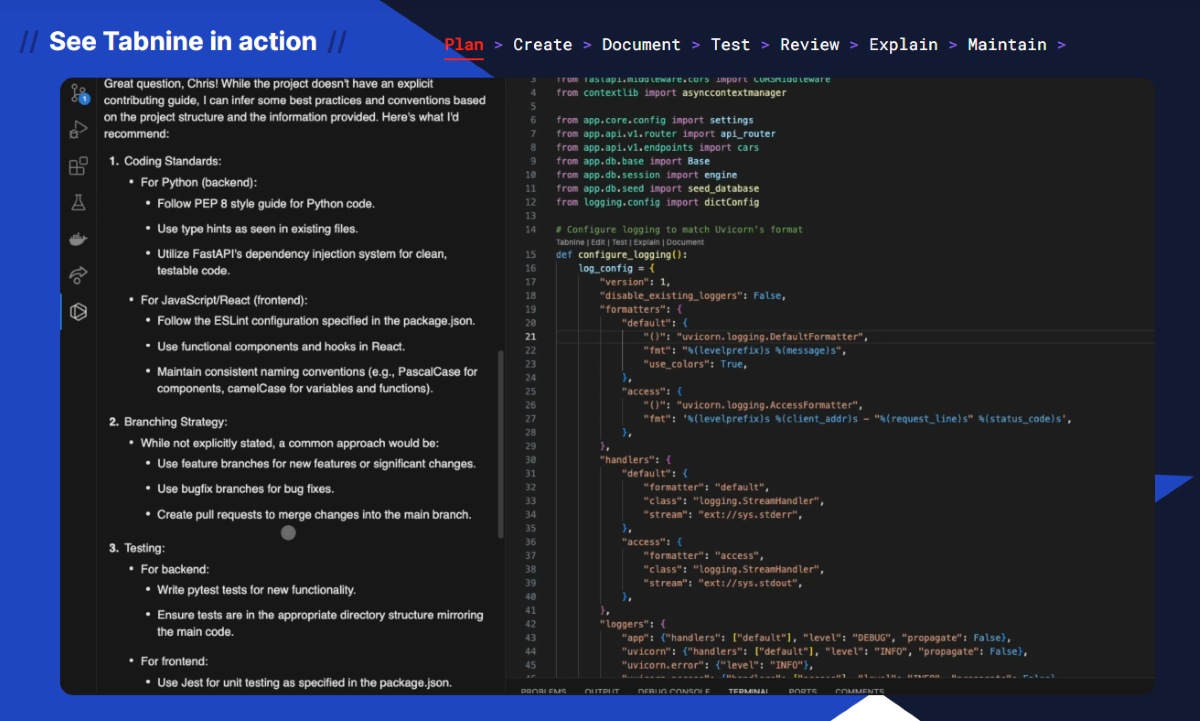
Before the current AI boom, developers relied heavily on a vibrant ecosystem of IDE plugins and bespoke automation scripts. Tools like Tabnine offered AI-powered code completion before it was cool, focusing specifically on predicting your next line of code with impressive accuracy, often trained on open-source codebases. Beyond commercial plugins, many developers create custom Git hooks, build scripts, or simple shell commands to automate repetitive tasks, enforce coding standards, or streamline deployment. These are the unsung heroes of developer productivity – small, focused, and often highly customized to a specific workflow or project.
Key Benefits
- Hyper-Customization: Tailored precisely to individual or team needs, often without vendor constraints.
- Lightweight & Fast: Typically less resource-intensive than large, cloud-based AI services.
- Offline Capabilities: Many plugins and scripts work entirely locally, addressing data privacy concerns.
- Immediate Impact: Small automations can yield significant daily time savings.
- Community-Driven: Many plugins benefit from active developer communities and open-source contributions.
Pricing
Many IDE plugins are free or open-source. Commercial plugins like Tabnine offer free tiers with basic functionality and paid subscriptions (often $10-20/month) for advanced features, private code training, or team integrations. Custom scripts are “free” in monetary terms, but require developer time to create and maintain, which is a different kind of cost. The investment is often in your own time and expertise.
Pros & Cons
The beauty of dedicated plugins and custom scripts is their precision and control. You know exactly what they do, and you can tweak them to your heart’s content. They’re fantastic for addressing very specific pain points in a developer’s workflow. However, their scope is inherently limited. A code completion plugin won’t help you with cloud infrastructure, and a Git hook won’t write your documentation. The maintenance burden of custom scripts can also grow over time, potentially offsetting initial productivity gains. For long-term strategic planning, even in your personal financial life, understanding the balance between immediate gains and long-term maintenance is key, much like architecting your Sovereign Wealth Stack.
How We Conducted Our Research
- Pricing: Evaluating market value and cost efficiency. We dug into free tiers, subscription models, and usage-based pricing to give you a clear picture of the financial commitment. We looked beyond the headline numbers to the actual cost per developer per month, considering the real ROI.
- Features: Identifying the “Must-Haves.” We didn’t just list every bells and whistle; we focused on features that directly contribute to developer productivity: code quality, speed of generation, integration capabilities, debugging assistance, and overall workflow enhancement. The goal was to identify what genuinely moves the needle.
- Negatives: Transparent debugging of missing features. No tool is perfect, and we believe in calling out the shortcomings. This includes potential issues like vendor lock-in, data privacy concerns, steep learning curves, or instances where AI suggestions might actually hinder more than help. It’s about managing expectations.
- Support: Community and refund policy checks. A great tool is only as good as the support behind it. We considered the robustness of documentation, the responsiveness of official support channels, and the vibrancy of community forums for troubleshooting and best practices. Because let’s be honest, you’re gonna have questions.
This comprehensive approach ensures we’re not just re-packaging marketing jargon, but providing actionable insights. We also made sure to cross-reference our findings with real-world developer feedback and industry reports. For instance, recent studies highlight the growing adoption of AI coding assistants, but also underscore concerns about security and intellectual property, reinforcing our focus on these ‘content gap’ areas. According to a recent survey from Stack Overflow, a significant percentage of developers are already using or plan to use AI tools, but they emphasize the need for robust security and clear ethical guidelines. (Source: Stack Overflow Developer Survey 2023 – AI Section).
Furthermore, understanding the evolving landscape of AI in development requires keeping an eye on official announcements and research. Google’s own AI blog often provides deep dives into their models and their applications for developers, giving us insights into upcoming features and best practices. (Source: Google AI Blog). We also consult independent analyses from tech journalism to get a balanced perspective on the strengths and weaknesses of these rapidly evolving platforms. For example, articles from publications like The Verge frequently cover the impact of generative AI on professional workflows, including software development. (Source: The Verge – AI News).
And speaking of staying sharp, if you’re looking to continuously expand your knowledge beyond just dev tools, I’ve found Audible to be an absolute game-changer. Whether it’s diving into new programming paradigms, brushing up on project management, or exploring psychological aspects of productivity, audiobooks let you learn on the go. It’s a fantastic way to keep your brain agile and ready for whatever 2025 throws at you.
Conclusion: Charting Your Course for Google AI Productivity Wins in 2025
So, after all that, what’s the verdict in the Google AI vs. specialized productivity tools debate? Is Google AI going to sweep the board and render your trusty specialized tools obsolete? Unlikely, at least not entirely, not yet. The ‘Google AI productivity wins 2025’ narrative is strong, but it’s about integration and ecosystem power rather than outright replacement.
Google AI, especially Gemini and the broader Cloud AI services, offers unparalleled potential for automation, large-scale code generation, and intelligent assistance, particularly if you’re already deeply invested in the Google Cloud ecosystem. Its strengths lie in its breadth and ability to connect dots across different aspects of development and deployment. It excels at tackling complex, multi-faceted problems that require a deep understanding of data and context.
However, specialized tools like GitHub Copilot, dedicated IDE plugins, and robust project management software still hold a vital place. They offer precision, deep integration into specific workflows, and often a level of control and privacy that a massive cloud AI might not provide. They’re the scalpel to Google AI’s Swiss Army knife – both incredibly useful, but for different kinds of operations.
My humble recommendation? Don’t pick a side. Embrace the hybrid model. Use Google AI for the heavy lifting, the cross-service automation, and the exploratory code generation. Lean on specialized tools for the nuanced, mission-critical coding, the hyper-efficient workflow management, and where local control or specific expertise is paramount. The developer who truly thrives in 2025 will be the one who intelligently orchestrates these tools, making them flow together, rather than trying to force one solution into every problem. It’s about building a robust, resilient workflow that uses the best of both worlds to amplify your intelligence, not replace it. Now go forth and build something awesome!